The Harvard Canary in the Innovation Coal Mine
- Jeff Dillon

- May 23, 2025
- 4 min read
Updated: Aug 15, 2025
On May 22, 7,000 international students at Harvard University became pawns in a political game that threatens to undermine America's greatest competitive advantage. The Trump administration revoked Harvard's ability to enroll foreign students, citing concerns about "anti-American, pro-terrorist agitators" on campus. Within 24 hours, a federal judge granted Harvard's request for a temporary restraining order, blocking the ban's implementation. While this legal victory provides temporary relief, the broader implications extend far beyond one university's battle with Washington.
The irony is staggering. As Chinese recruiters actively court American-trained talent on social media, we're literally banning the world's brightest minds from our most prestigious institutions. This isn't just about Harvard, it's about America systematically dismantling the innovation engine that transformed us into a global superpower.
Universities: America's Secret Weapon
The Manhattan Project offers an historical parallel. When European scientists fled fascist regimes in the 1940s, they didn't scatter randomly across the globe—they flowed to American universities like Berkeley, MIT, Princeton, and Columbia. These refugee scholars, working alongside American researchers, built the atomic bomb that ended World War II. As physicist Niels Bohr observed, the government succeeded by "turning the whole country into a factory."
If those rivers of talent had flowed in the opposite direction, the world would look dramatically different today. Hitler could have developed nuclear weapons first. Instead, America became the destination for global intellectual capital, establishing a pattern that has persisted for eight decades.
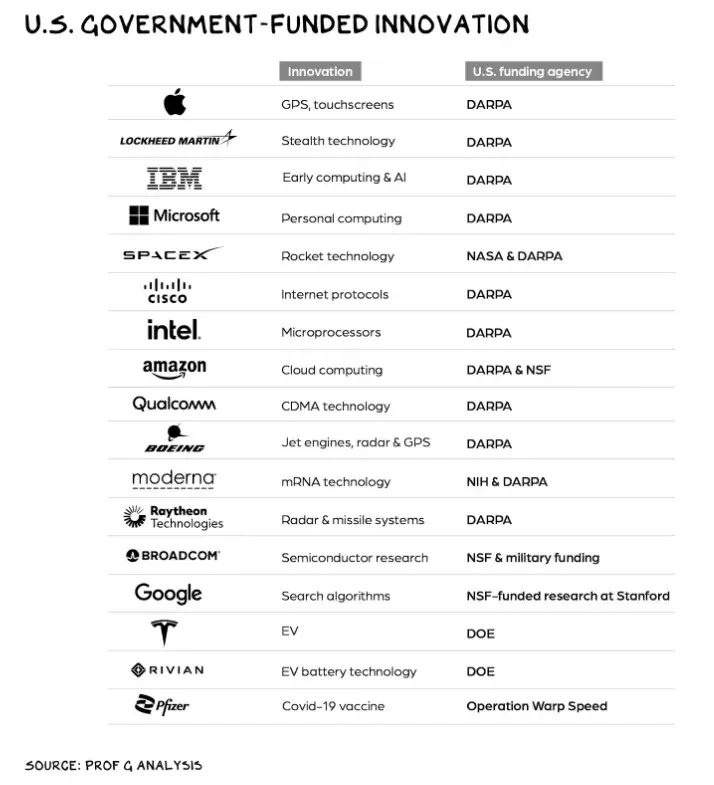
The world's most valuable companies are based in the United States, built on foundations of government-funded university research.

What makes American universities unique isn't just the quality of education, it's the ecosystem they create. Universities serve as talent magnets, research laboratories, and startup incubators simultaneously. This triple function doesn't exist anywhere else in the world with the same intensity and scale.
The DARPA Difference
No corporation can match the Defense Advanced Research Projects Agency's role as an engine of American innovation. DARPA represents something unique in the global economy: patient capital invested in breakthrough research that companies focused on quarterly earnings simply cannot justify. Early-stage research requires massive investments with uncertain returns over decades, not quarters.
Consider the technologies that define modern life: the internet, GPS navigation, touchscreen interfaces, voice recognition, and mRNA vaccines. Every single breakthrough originated from government-funded research conducted at American universities, then commercialized through public-private partnerships.
This visualization demonstrates how extensively our most valuable companies depend on government-funded research. Apple's Siri uses DARPA-funded artificial intelligence research. Google's search algorithms built on National Science Foundation grants. Tesla's battery technology traces back to Department of Energy investments. The pattern repeats across every major technology company.
The PhD Pipeline Under Threat
Harvard's international students aren't tourists, they represent 27% of the university's enrollment and include many of our future Nobel laureates and entrepreneurs. These PhD students don't just conduct research; they supervise American undergraduates, teach courses, and multiply knowledge transfer throughout the institution.
When a brilliant physicist from Germany or a computer scientist from India arrives at an American university, they don't just add their individual capabilities. They create networks, collaborate across disciplines, and often become the professors who train the next generation of American innovators. The compound effect of international talent extends far beyond individual contributions.
After the White House announced research layoffs at the CDC, NIH, and NOAA, Chinese recruiters immediately jumped on social media to tout career opportunities in Shenzhen. More than 1,200 American scientists told the journal Nature they were considering leaving America, three-quarters of all respondents in a recent poll.
The Great Reversal
European leaders aren't wasting time exploiting America's self-inflicted wounds. The European Commission announced €500 million to court international researchers, while France committed another €100 million to make Europe a "safe haven" for science. President Emmanuel Macron's words sting with their accuracy: "No one could have thought that one of the largest democracies in the world would erase, with a stroke of the pen, the ability to grant visas to certain researchers."
The United Kingdom is considering a £50 million program to court researchers, while Australia, Canada, the Netherlands, and Norway advance their own talent-recruitment plans. Even regions within countries are competing, Catalonia unveiled a €30 million "Talent Bridge" specifically to finance posts for American researchers facing academic restrictions.
This represents more than policy disagreement, it's about long-term competitive advantage. China already produces more published research papers than America, and the number of Chinese universities in global top-100 rankings doubled over the past five years while American representation declined.
The Economic Reality
The numbers behind innovation policy aren't abstract. Economists at American University found that a 25% cut to public R&D spending would reduce GDP by 3.8%, comparable to the Great Recession. A 50% reduction would lower GDP by almost 7.6%, making every American significantly poorer.
Innovation doesn't follow linear progression. Each breakthrough enables dozens of others, creating exponential returns over decades. The university research we defund today won't show its absence until 2045, when other nations dominate industries that don't yet exist.

Research laboratories at universities across the country demonstrate this energy, brilliant minds from every continent working together, pushing boundaries, creating the future. International PhD students don't threaten American innovation; they supercharge it.
The Harvard international student ban represents more than institutional politics. It's a canary in the coal mine, warning that America is abandoning the policies that created our prosperity. We can reverse course, but the window is closing rapidly as other nations eagerly welcome the talent we're turning away.
Our choice is simple: continue as the world's innovation magnet, or hand that advantage to competitors who understand its value better than we apparently do.